
 Español
 Portugues
 Pусский
 Deutsch
 한국어
한국어 العربية
 Italiano
 Svenska
 ไทย
ไทย Türk dili
 Indonesia
 Melayu
 Tiếng Việt
 қазақ
қазақ বাংলা
বাংলা українська
 norsk
norsk Filipino
 o'zbek

Conventional Horizontal Lathe
Conventional Horizontal Lathe: An Overview A conventional horizontal lathe is a fundamental machine tool used in metalworking and woodworking to perform various operations such as turning, facing, threading, grooving, and drilling. It is characterized by its horizontal spindle orientation, where the workpiece rotates along a horizontal axis while the cutting tool moves linearly to remove material. This design has been widely used for decades due to its versatility, reliability, and ability to handle a broad range of workpiece sizes and shapes. Key Components 1. Bed: The rigid base that supports all other components, ensuring stability and precision during machining. 2. Headstock: Houses the main spindle, gears, and motor, providing rotational power to the workpiece. 3. Tailstock: Located opposite the headstock, it supports long workpieces with a center or holds tools for drilling or reaming. 4. Carriage: Moves along the bed and holds the cutting tool, consisting of the saddle, cross-slide, and tool post. 5. Lead Screw and Feed Rod: Control the longitudinal and transverse movement of the carriage for threading and feeding operations. 6. Chuck or Faceplate: Secures the workpiece to the spindle, with options like three-jaw (self-centering) or four-jaw (independent) chucks. Working Principle The workpiece is clamped in the chuck or between centers, and the spindle rotates it at a controlled speed. The cutting tool, mounted on the carriage, is fed into the workpiece either manually or automatically to achieve the desired shape. By adjusting the tool position and spindle speed, operators can produce cylindrical, conical, or complex profiles with high accuracy. Applications - Turning: Creating cylindrical or tapered surfaces. - Facing: Producing flat surfaces perpendicular to the spindle axis. - Threading: Cutting internal or external threads. - Boring: Enlarging existing holes with precision. - Knurling: Adding grip patterns to cylindrical parts. Advantages - Versatility: Suitable for a wide range of materials (metals, plastics, wood). - Precision: Capable of achieving tight tolerances with skilled operation. - Durability: Robust construction ensures long service life. - Ease of Use: Simple setup and operation for basic machining tasks. Limitations - Manual Operation: Requires skilled labor for complex jobs. - Lower Productivity: Slower than CNC lathes for high-volume production. - Limited Automation: Lacks advanced features like programmable tool paths. Despite the rise of CNC technology, conventional horizontal lathes remain essential in workshops for prototyping, maintenance, and small-batch production due to their simplicity and cost-effectiveness.
Products
Category:
-
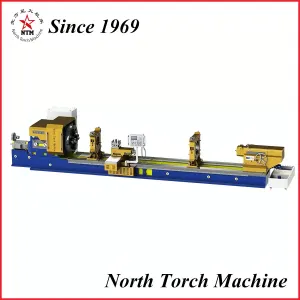
Conventional Horizontal Lathe
Category: Large Horizontal LatheBrowse number: 52Number:Release time: 2025-11-25 13:55:20CX61 Series Large Conventional Horizontal lathe can realize various turning processes, such as the outer circle, end face, inner hole, cutting groove, thread, R arc and other processes, it is also suitable for hard alloy tools for strong turning, processing a variety of ferrous and non-ferrous metals. The main part of the machine tool uses the international advanced computer technology and the optimization finite element analysis method,which make the lathe has a large load capacity, the design is reasonable, the material choice is exquisite.All castings are made of high strength and high grad...
News
Category:
-
[Industry news] Roll CNC lathe – What are the best software options?
2025-11-29 09:11:18
Case
Category:
No search results found!
Video
Category:
No search results found!
Download
Category:
No search results found!
Job
Category:
No search results found!
Featured Products
-
NEWS
Conventional Horizontal Lathe
Learn more



 Phone
Phone